Real experiment
One App, Three Store Screenshot Directions: A Real Genshot Experiment
A transparent Genshot production experiment comparing three visual directions for the same MyPR source sequence, with real generation IDs, outputs, failures, and limits.
Short answer
Changing visual direction produced meaningfully different store-image families, but direction alone did not fix copy repetition or source-order mistakes. The useful workflow was generate, inspect by run ID, select, and refine—not accept the first set.
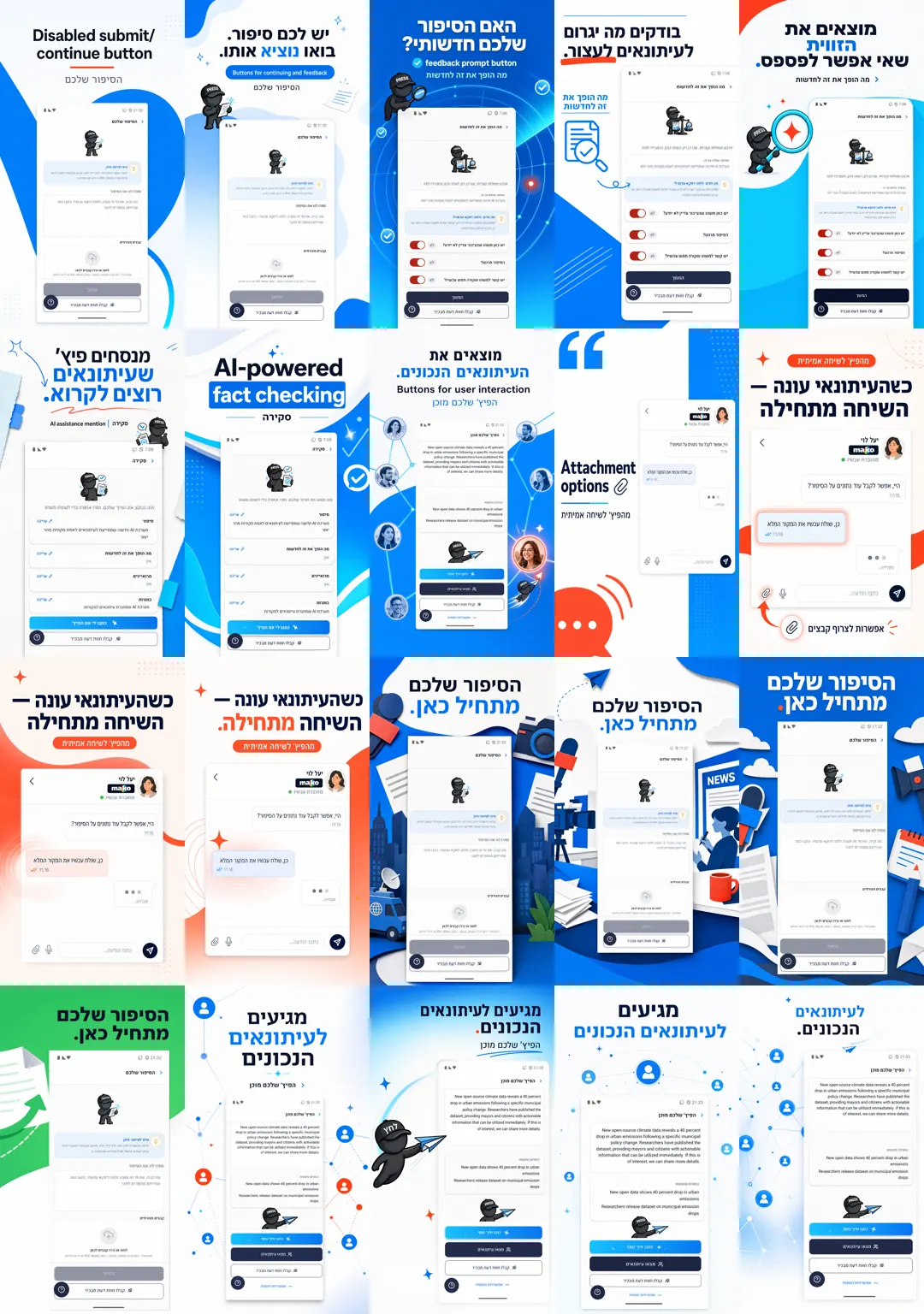
What this experiment is—and is not
The source was MyPR, a Hebrew public-relations app. The tracked campaign targeted Google Play portrait screenshots at 1080×1920. We are publishing it because it is a real Genshot workflow with inspectable identifiers, not because Android dimensions answer an iOS requirement.
No App Store conversion test was run. There is no claim that one direction earns more downloads. The observations cover composition quality, copy distribution, source order, device treatment, and palette consistency.
The three production directions
| Direction | Generation ID | What worked | What failed |
|---|---|---|---|
| Signal path | gen_5abc52417ff2eaa058101efd296f870f | Strong geometric system. | Fourth image combined copy groups. |
| Friendly PRESS | gen_8bbab2e559e8c2b195cd4d19a08b730e | Warm layouts and correct source sequence. | All four repeated the first copy group. |
| Breaking editorial | gen_bdaa7f71f4eac09a4a5ccf25e54fce6b | Boldest poster direction. | Repeated copy and changed source order. |
How the comparison was reviewed
- Step 1
Freeze the input
Keep the same four product moments and target dimensions.
- Step 2
Vary the direction
Change the visual system while keeping the product story comparable.
- Step 3
Inspect every Generation
Use the Generation ID to retrieve attempts, image order, and provider evidence.
- Step 4
Score failures explicitly
Record copy repetition, invented text, palette drift, source order, and device-frame mistakes.
genshot generations inspect gen_5abc52417ff2eaa058101efd296f870f --json
genshot generations inspect gen_8bbab2e559e8c2b195cd4d19a08b730e --json
genshot generations inspect gen_bdaa7f71f4eac09a4a5ccf25e54fce6b --json
What we would change in the next run
- Bind one ordered caption to each source screen instead of supplying copy as a loose group.
- Reject repeated headlines before considering visual polish.
- Make source-order preservation a quality-check field.
- Separate “no device frame” from “no device-like rounded shell” in the visual constraint.
- Choose a direction only after reviewing the complete carousel at thumbnail size.
Sources and verification
Product capabilities and changing requirements were checked against these primary pages. External pages can change after the verified date above.
Related App Store screenshot resources
Understand what AI still needs reviewed
Use the successful and failed observations to set a stronger review loop.
Understand what AI still needs reviewed